Engineered Food Proteins: Fermentation as an Alternative to Animal Protein (2026)
Fermentation is no longer just about beer, yoghurt, and sourdough. In 2026 it is also one of the most practical ways to produce high-quality protein ingredients with far less reliance on livestock. The idea is simple: instead of growing an animal to obtain protein, you grow microorganisms that either become the protein themselves or are used to make specific proteins. The details, however, matter—because the type of fermentation, the organism, the feedstock, and the downstream processing determine nutrition, taste, price, and how regulators classify the final ingredient.
What “engineered food proteins” means in practice
In everyday food manufacturing, “engineered” usually means the protein is designed for a job: emulsifying, foaming, gelling, binding water, or delivering a specific amino-acid profile. With fermentation, that design can happen in two main ways. The first is to select or improve a microbe that naturally produces a useful protein or grows into a protein-rich biomass. The second is to introduce a genetic blueprint so a microbe produces a specific target protein—often one that is identical (or very close) to an animal protein.
It helps to separate three buckets that are often mixed together in media coverage. Traditional fermentation uses familiar microbes to transform a raw material (think cheese cultures or soy sauce). Biomass fermentation grows the microbe itself as the main food ingredient (many fungal and yeast proteins fit here). Precision fermentation uses a microbe as a “cell factory” to make a particular molecule—such as whey proteins, casein, egg-white proteins, or certain functional proteins used in baking and beverages.
By 2026, you can see all three approaches on shelves, but not always labelled in a way consumers recognise. Biomass proteins might be described as “mycoprotein”, “fermented fungal protein”, or “yeast protein”. Precision-fermented ingredients are more likely to appear in the ingredient list as the protein name itself (for example, a whey protein) plus information about how it was produced, depending on local labelling expectations and legal definitions.
How fermentation replaces livestock at the ingredient level
The core advantage is efficiency. Livestock converts feed into edible protein with large biological overheads: maintenance energy, bones, organs, heat loss, and methane in ruminants. Fermentation moves production into tanks where temperature, oxygen, and nutrients are controlled. That control enables consistent output and makes it easier to standardise quality, which matters for large food brands that need predictable performance in recipes.
Precision fermentation is sometimes described as “making animal proteins without animals”, but that phrase hides important steps. After fermentation, the target protein usually needs separation and purification, then drying or formulation into an ingredient that behaves well in real foods. Each step affects cost and the final environmental footprint. Energy for aeration, sterilisation, and drying can be significant, so factories increasingly focus on heat integration and efficient downstream processing rather than fermentation alone.
Biomass fermentation can be simpler because the organism itself is eaten, but it comes with its own technical constraints. The producer must control nucleic acid levels, cell-wall components, and flavour-active compounds so the ingredient is safe, digestible, and neutral enough for mainstream products. This is why many biomass proteins are paired with familiar culinary formats—minced products, fillets, nuggets, or blended foods—where texture engineering can compensate for what the raw biomass cannot do on its own.
Safety, nutrition, and allergen reality checks
From a food-safety viewpoint, fermentation is not automatically “safer” or “riskier” than farming—it is simply different. The safety case typically depends on (1) the production organism, (2) what goes into the fermenter, (3) what remains in the finished ingredient, and (4) how reliably the producer can prevent contamination. In modern facilities, sterility controls, validated cleaning, and continuous monitoring are the foundation, because unwanted microbes can spoil batches or create toxins.
Nutritionally, fermented proteins vary widely. Some biomass proteins provide fibre-like components and a strong amino-acid profile, but may need attention to digestibility and certain micronutrients depending on formulation. Precision-fermented proteins can be extremely targeted—useful when you want a specific functional protein, but not necessarily a “complete food” by itself. As a result, many 2026 products use blended strategies: a fermented ingredient for function and texture, combined with legumes, grains, or oils to reach desired nutrition and cost targets.
Allergen considerations are where marketing claims often become sloppy. If a precision-fermented protein is identical to an allergenic animal protein (for example, a milk whey protein), it should be treated as an allergen for sensitive consumers regardless of the absence of animals in production. On the biomass side, fungal proteins can trigger reactions in a small subset of people, and manufacturers have to manage that risk through clear information and robust quality controls.
Regulation in 2026: why “approved” depends on where you are
Regulatory pathways differ sharply between jurisdictions, and that shapes which products reach which markets. In the United States, a common route for certain ingredients is the GRAS framework, where companies compile safety dossiers and may notify the FDA. Public records show precision-fermented dairy proteins have been reviewed in this way for specific uses, which helps explain why some animal-identical proteins appear in US products earlier than in parts of Europe.
In the UK and EU, novel-food style assessments and authorisation timelines can be a bottleneck, especially for newer precision-fermented proteins aimed at mass markets. The UK has been running targeted support initiatives to help businesses navigate authorisation and evidence requirements, signalling that regulators expect a growing pipeline of fermentation-derived ingredients rather than a one-off trend.
The practical takeaway for 2026 is that a product’s availability is not a pure reflection of scientific readiness; it is also about the pace of dossier review, the clarity of labelling expectations, and whether a company can finance a long approval process. That is why you can see plenty of fermentation-derived proteins in headlines while local supermarket reality still looks more incremental: blended products, limited launches, and ingredient-level adoption inside familiar foods.
Scaling and sustainability: where fermentation wins, and where it struggles
Fermentation can reduce land demand by decoupling protein output from pasture and feed crops, but sustainability claims must be tied to specifics. Feedstock choice matters (sugar, starch hydrolysates, agricultural residues), as does energy sourcing. A facility powered by low-carbon electricity and designed for heat recovery looks very different from one relying on fossil-heavy grids and inefficient drying. So, the right comparison is not “fermentation vs cows” in the abstract, but “this process in this place with this energy mix”.
Costs in 2026 are still driven by two expensive zones: sterile operation and downstream processing. Precision fermentation often needs filtration, chromatography-like steps, and careful drying to achieve purity and function, which can dominate unit economics. Biomass fermentation may avoid extreme purification, but must still solve taste, colour, and texture issues at scale, and that requires processing, formulation, and consistent supply chains.
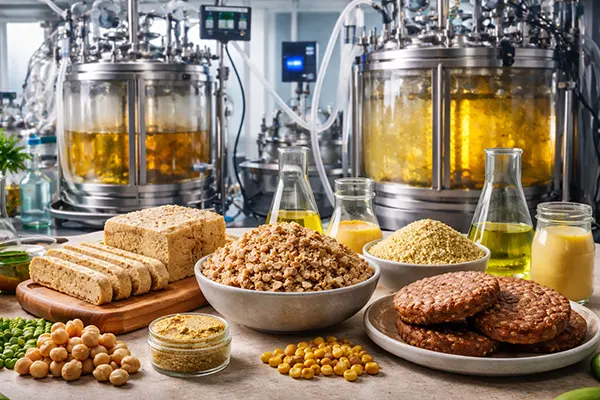
There is also a scale threshold where fermentation stops being a lab story and becomes industrial manufacturing. Large bioreactors, reliable microbial performance, stable raw-material contracts, and qualified staff are not optional. The industry has learned that the “biology” part can be easier than building a dependable factory that runs day after day with food-grade compliance. That is why partnerships with established food manufacturers and ingredient companies have become a common route to commercial scale.
What to look for on labels and in product claims
For consumers, the simplest rule is to focus on the actual ingredient name, not the buzzwords. If the ingredient is a milk protein, it should be treated as milk for allergy purposes even if it was produced by fermentation. If the ingredient is fungal or yeast biomass, look for straightforward wording that makes the source clear. Vague phrases such as “animal-free” can be technically true while still masking allergen reality.
For businesses buying ingredients, the key questions are operational rather than ideological. What is the spec range batch-to-batch? What are the microbiological limits and testing cadence? How does the ingredient behave under heat, shear, freezing, and acidic conditions? Fermentation-derived proteins can be excellent, but only if the supplier can document stability, shelf life, and performance across your actual manufacturing process.
Finally, transparency is becoming a commercial asset, not just a compliance step. In 2026, the most credible brands explain what organism is used, what the protein is, and why it was chosen—without overselling. That approach reduces backlash, helps allergen-aware shoppers, and lowers the risk of legal disputes tied to impression-based marketing. In other words: the science can be sophisticated, but the public explanation should remain plain, specific, and verifiable.