Spatial Displays for Cars: Navigation and Warnings in the Road View
Spatial displays are changing how drivers receive directions and safety information. Instead of forcing someone to look down at a dashboard or central screen, these systems place selected graphics in the forward field of view, where they appear to sit several metres ahead or align with a lane, junction or hazard. By 2026, the idea is no longer limited to prototypes. Augmented-reality head-up displays are fitted to production vehicles from several major manufacturers, while high-resolution digital headlights can project guidance lines and warning symbols onto the road itself. The result is a more direct link between information and the place where the driver needs to act. Yet the technology works best when it remains restrained. Clear arrows, speed limits and urgent warnings can support attention; crowded graphics, poor calibration or unnecessary notifications can create a new form of distraction.
What Spatial Displays Actually Show
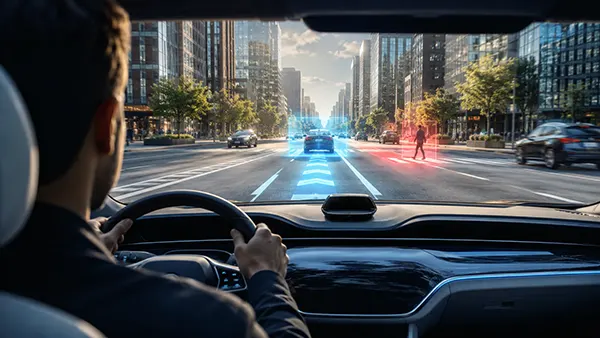
A conventional head-up display usually presents speed, a speed-limit sign and a simple navigation instruction on the windscreen. A spatial or augmented-reality display goes further by trying to attach that information to the outside scene. A turn arrow may appear to rest over the correct street, a highlighted lane may show where the car should move, and a distance marker may seem to sit near the vehicle ahead. The image is not painted on the glass in a fixed position. It is continually adjusted so that the graphic remains useful as the car changes speed, direction and position. This gives the driver a stronger sense that the instruction belongs to the road rather than to a separate screen inside the cabin.
Most production systems described as projecting information “onto the road” do not shine navigation graphics onto the asphalt. They create a virtual image through the windscreen, positioned at a distance in front of the car and aligned as closely as possible with real lanes or objects. This distinction matters because the display is visible only from the driver’s seating position and can work in daylight. It also explains why calibration is important: if the driver changes seat height, the windscreen is replaced or the system loses an accurate position reference, an arrow may no longer appear exactly where expected. Good spatial alignment depends on the display, the driver’s viewpoint and the car’s understanding of its surroundings working together.
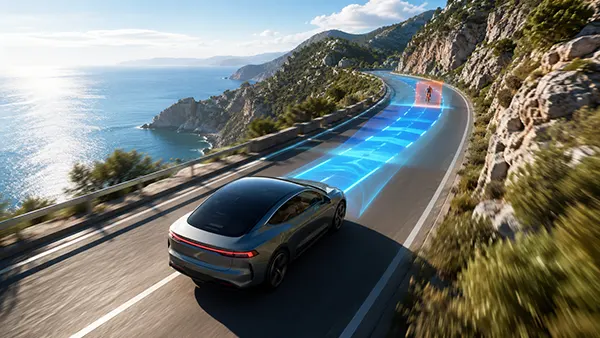
A second category uses digital headlights to place actual light patterns on the road surface. These systems are mainly useful at night and can create lane-width guides in roadworks, illuminate the intended lane, mark the direction of a lane change or add a warning symbol ahead of the vehicle. Unlike a windscreen image, this light is physically visible on the carriageway and may also be seen by nearby road users. The function is more limited in bright conditions, and manufacturers must control glare carefully, but it gives drivers an immediate reference that follows the shape of the road. In 2026, the two approaches often complement one another rather than compete: the windscreen handles detailed information, while the headlights provide simple, high-contrast guidance.
From Windscreen Images to Road-Surface Light
Mercedes-Benz helped establish the modern augmented-reality head-up display in series-production cars. In the S-Class, navigation arrows can be placed virtually over the appropriate lane, while driver-assistance information appears in the same forward view. The virtual image is presented at a distance of about ten metres and is described as having an apparent display area comparable to a 77-inch screen. Volkswagen has taken a similar idea into a broader range of electric cars. The ID.7 includes an augmented-reality head-up display as standard in its range, using a near layer for basic data and a farther layer for lane-level navigation. These examples show how the technology has moved from a novelty into a practical part of everyday route guidance.
BMW’s approach in the new iX3 adds a different type of spatial presentation. The Panoramic Vision system places information across a darkened strip at the lower edge of the windscreen, keeping essential driving data close to the road view without covering the central scene. An optional 3D head-up display above it handles navigation and assisted-driving cues with a stronger sense of depth. The iX3 entered the European market in 2026 as the first series model in BMW’s Neue Klasse generation, making this arrangement a current production example rather than a distant concept. It also shows that future cabins may use several carefully coordinated display zones instead of relying on one large central touchscreen.
Physical road projection has also reached production vehicles. Mercedes-Benz DIGITAL LIGHT can place guidance markings and selected warning symbols on the carriageway, including lines that help show the car’s width through a narrowed section. Audi’s digital matrix LED systems can produce orientation and lane lighting, and the 2025-generation Q3 introduced a compact micro-LED unit designed to project detailed light images onto the road. Porsche uses high-resolution matrix lighting to keep a bright lane-shaped area in front of the car and adapt it during lane changes. These functions are not substitutes for navigation or hazard detection, but they demonstrate that “information on the road” can mean both a virtual windscreen overlay and a real pattern of controlled light.
How Navigation Becomes Easier to Read
The main advantage of spatial navigation appears at places where a flat map can be ambiguous. A voice instruction such as “take the second exit” may be easy on an empty roundabout but less clear at a wide junction with several lanes, temporary markings and closely spaced turnings. A correctly aligned arrow can point towards the exact branch, while a lane ribbon can show where the car should be before the manoeuvre begins. The driver still needs to read signs and judge traffic, but the route instruction is linked to the scene rather than presented as an isolated symbol. This can reduce the mental step of translating a small map into a decision about the road ahead.
Motorway guidance benefits for the same reason. Conventional navigation may say that an exit is two kilometres away, yet the important question is often which lane will continue towards the destination. Spatial displays can introduce the lane recommendation early, keep it visible as the junction approaches and then remove it once the manoeuvre is complete. This progressive timing is more useful than a permanent arrow that occupies the windscreen for too long. It can also help at complex interchanges where several exits appear in quick succession. The strongest designs show only the next action, using position and distance to make the instruction understandable without requiring the driver to study a detailed map.
For the illusion to remain convincing, the car needs a reliable estimate of its own position. Satellite navigation alone may not be precise enough near tall buildings, tunnels or multilane junctions, so vehicle systems can combine map data with cameras, wheel-speed information, steering input and other sensors already used by driver assistance. The aim is not to create a perfect digital copy of every road. It is to keep the arrow or highlight stable enough that the driver does not question which lane or object it refers to. When confidence falls, a responsible system should simplify the display or return to a conventional instruction rather than maintain a precise-looking graphic that may be misplaced.
Warnings That Appear Where Attention Is Needed
Safety warnings are most valuable when they identify both the type and location of a risk. A generic red symbol can tell the driver that something is wrong, but a spatial cue may indicate that the concern is a pedestrian near the left kerb, a stopped vehicle in the current lane or traffic slowing beyond a bend. The 2026 Cadillac VISTIQ provides a current example of this direction, with an augmented-reality head-up display designed to highlight approaching vehicles or pedestrians and place navigation arrows in the forward scene. Similar ideas appear in other premium systems, although the exact functions vary by country, specification and software version.
Spatial cues can also make driver-assistance activity easier to understand. When adaptive cruise control follows another vehicle, a marker can show which vehicle the system has selected. When lane support is active, a subtle line can indicate the recognised lane boundaries. During a request to take back control from an automated function, an arrow or highlighted hazard can show why the driver’s attention is needed. This matters because assistance systems can feel unpredictable when they act without a visible reason. A carefully placed cue can connect the car’s response to something the driver can see, supporting trust without suggesting that the system understands more than it actually does.
The challenge is deciding what not to show. Speed, navigation, lane support, blind-spot alerts, phone notifications and entertainment prompts cannot all compete for the same forward view. Urgency should determine priority. An imminent collision warning must replace less important content, while routine status information should stay small and stable. Graphics should disappear once their purpose has passed, and colour should be used consistently rather than decoratively. The best display is not the one with the largest field of view or the greatest number of effects. It is the one that gives the driver one clear message at the moment when that message can support a safe decision.
What Drivers Can Expect From 2026 Cars
By 2026, augmented-reality head-up displays are available in several production segments, but they are not yet a universal replacement for instrument panels. Some cars use a traditional compact head-up display, some add a distant navigation layer, and others combine a lower windscreen strip with a separate 3D image. Availability often depends on trim level, optional equipment and local rules. Even when the hardware is fitted, connected navigation, hazard data or advanced driver-assistance cues may require active services. Buyers should therefore check the functions of the exact car rather than assume that every system carrying an augmented-reality label can mark pedestrians, display lane-level directions or project warnings onto the road surface.
The market is also becoming less limited to one visual formula. Volkswagen’s ID.7 treats the augmented-reality display as the primary source of journey information, allowing the conventional instrument area to remain small. BMW divides content between a full-width lower windscreen display and an optional spatial head-up image. Cadillac’s VISTIQ uses a full-colour holographic display for route and hazard cues. Mercedes-Benz combines an in-cabin augmented-reality display with optional digital headlight projection on selected models. These approaches reflect different answers to the same question: how can a car present useful information close to the road without blocking the scene or demanding too much attention?
Ownership brings practical considerations that do not apply to an ordinary dashboard screen. Windscreen glass may need to be made specifically for the head-up display to avoid double images. Metallic tint films can interfere with visibility, while polarised sunglasses may make some projected content difficult to see. Seat position, display height and brightness should be adjusted before driving, not while moving. A replacement windscreen may also require calibration so that navigation and warning graphics appear in the correct place. These details do not make spatial displays fragile, but they mean the driver, repairer and insurer should treat the windscreen as part of an optical system rather than as a simple sheet of glass.
Safety Limits and the Direction of Development
Keeping information close to the road does not automatically remove distraction. Research on augmented-reality head-up displays has found that graphic position, opacity and complexity can change where drivers look and what they notice. A bright overlay may draw attention to a marked hazard while making an unexpected object nearby easier to miss. Dense displays can also encourage “perceptual tunnelling”, where the driver concentrates on the graphics and pays less attention to the wider scene. Recent studies therefore support a restrained design with clear hierarchy, limited content and careful testing in different traffic conditions. The relevant question is not simply whether a display is visible, but whether it improves awareness without hiding or competing with important real-world information.
Environmental conditions remain another limit. Strong sunlight, reflections, wet roads, dirty glass, fog and highly reflective signs can reduce contrast or make a projected image harder to interpret. Polarised lenses and an incorrect seating position may affect visibility, while roadworks and temporary lane markings can expose errors in map-based guidance. Camera or radar obstruction can also reduce the accuracy of hazard cues. For this reason, spatial displays must remain supplementary. Drivers should continue to follow road signs, check mirrors, observe blind spots and respond to the actual traffic situation. A virtual arrow is useful guidance, not authority over what is physically happening outside the car.
The next stage is likely to focus less on filling the windscreen and more on deciding when spatial information earns a place there. Better positioning can make arrows steadier, improved eye tracking can adjust the image for different drivers, and shared data can warn about hazards beyond the camera’s immediate view. At the same time, manufacturers will need consistent visual rules so that a red boundary, a highlighted pedestrian or a takeover request means the same thing across models. In 2026, the most convincing systems already show the central principle: navigation and warnings become easier to understand when they are linked to the road, but only when the display remains accurate, selective and subordinate to the driver’s own observation.