Carbon-Neutral Data Centres: Technologies That реально Reduce AI Infrastructure Energy Use
The rapid expansion of artificial intelligence has pushed data centre energy demand to unprecedented levels. Training large-scale models and running inference workloads require vast computational power, which directly translates into electricity consumption and heat generation. By 2026, the conversation has shifted from theoretical sustainability goals to measurable efficiency gains. Operators are now deploying a combination of hardware optimisation, cooling innovation, and energy sourcing strategies to move towards carbon-neutral operations while maintaining performance.
Energy-Efficient Hardware and Workload Optimisation
Modern AI infrastructure increasingly relies on specialised chips designed for specific workloads rather than general-purpose processors. GPUs remain dominant, but tensor processing units (TPUs), AI accelerators, and custom ASICs are reducing energy per computation significantly. Compared to traditional CPUs, these chips can deliver multiple times higher performance per watt, which directly lowers the overall energy footprint of training and inference tasks.
Another critical factor is workload orchestration. Advanced scheduling systems distribute AI tasks across servers based on real-time energy availability and hardware efficiency. For example, non-urgent training jobs can be shifted to periods when renewable energy supply is high or when cooling demand is lower. This approach reduces peak energy loads and improves utilisation across the infrastructure.
Model optimisation techniques also play a central role. Methods such as quantisation, pruning, and distillation reduce the size and computational complexity of AI models without significantly affecting accuracy. In practice, this means fewer computations, shorter training cycles, and lower electricity consumption, especially in large-scale deployments.
Software-Level Efficiency and Algorithmic Improvements
Energy reduction is not limited to hardware. Software frameworks are becoming more efficient, with libraries optimised for parallel processing and reduced memory overhead. Improvements in compilers and runtime environments allow models to execute faster and consume fewer resources, particularly in distributed systems.
Algorithmic innovation is equally important. Researchers are focusing on training methods that converge faster, such as adaptive learning techniques and more efficient optimisation algorithms. Faster convergence means fewer training iterations, which directly reduces total energy usage over the lifecycle of a model.
In production environments, inference optimisation has a noticeable impact. Techniques like batching requests and using edge inference reduce the need for constant communication with central servers. This lowers both computational load and network-related energy consumption, which is often overlooked in sustainability discussions.
Advanced Cooling Technologies and Thermal Management
Cooling remains one of the largest contributors to data centre energy consumption. Traditional air cooling systems are increasingly being replaced or supplemented by liquid-based solutions. Direct-to-chip liquid cooling, for instance, transfers heat more efficiently than air, allowing systems to operate at higher densities without overheating.
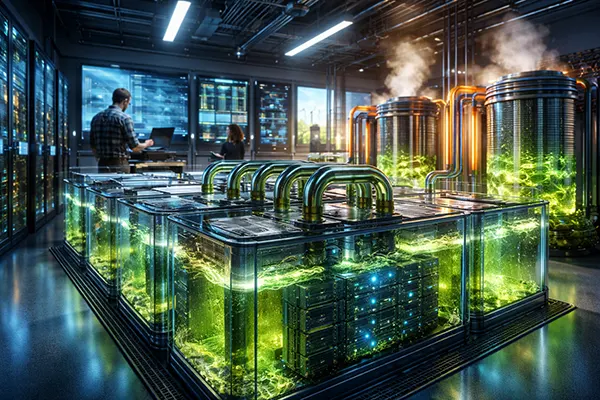
Immersion cooling is gaining traction as a scalable solution for AI workloads. Servers are submerged in non-conductive fluids that absorb heat directly from components. This approach significantly reduces the need for energy-intensive fans and air conditioning systems, leading to lower overall power usage effectiveness (PUE) values.
Heat reuse strategies are also becoming standard practice. Instead of dissipating waste heat, some facilities redirect it to nearby buildings or industrial processes. In colder regions, data centre heat is used for district heating, turning a by-product into a resource and improving the overall energy balance.
Smart Thermal Control and AI-Driven Cooling
Ironically, artificial intelligence itself is being used to reduce energy consumption in data centres. AI-driven cooling systems analyse temperature patterns, airflow, and workload distribution in real time. These systems adjust cooling dynamically, ensuring that energy is not wasted on overcooling underutilised areas.
Predictive maintenance is another area where efficiency gains are evident. By identifying potential cooling system failures early, operators can prevent inefficiencies and avoid emergency energy spikes caused by malfunctioning equipment. This leads to more stable and predictable energy usage.
Additionally, facility design is evolving to support natural cooling wherever possible. Data centres are increasingly located in regions with cooler climates or access to natural water sources. Combined with free-air cooling techniques, this reduces reliance on mechanical cooling systems and lowers long-term operational costs.
Renewable Energy Integration and Grid Interaction
Achieving carbon neutrality requires not only reducing energy consumption but also changing how that energy is sourced. Leading data centre operators are investing heavily in renewable energy contracts, including wind, solar, and hydroelectric power. By 2026, long-term power purchase agreements (PPAs) have become a standard tool for ensuring a stable supply of low-carbon electricity.
On-site energy generation is also expanding. Solar panels installed on data centre campuses and battery storage systems allow operators to manage energy more flexibly. During periods of high renewable output, excess energy can be stored and used later, reducing dependence on fossil-fuel-based grid electricity.
Grid interaction strategies are becoming more sophisticated. Data centres can now act as flexible loads, adjusting their consumption based on grid conditions. This not only reduces costs but also supports grid stability, especially in regions with high renewable energy penetration.
Energy Storage and Demand Response Strategies
Battery technology plays a crucial role in balancing supply and demand. Modern data centres use advanced lithium-ion and emerging solid-state batteries to store energy and ensure uninterrupted operation. These systems also enable participation in demand response programmes, where facilities reduce consumption during peak demand periods.
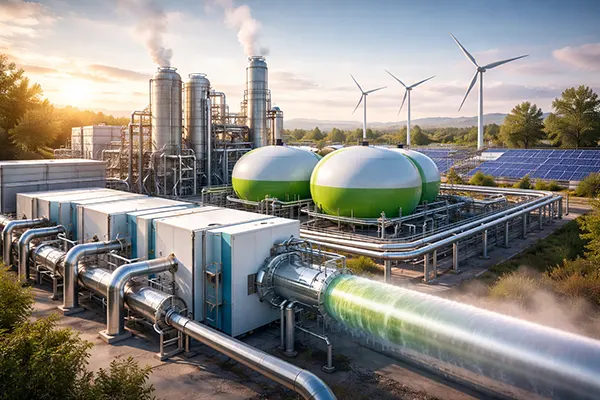
Hydrogen-based energy storage is being explored as a long-term solution for large-scale facilities. Although still developing, hydrogen systems offer the potential for storing renewable energy over extended periods, addressing one of the key limitations of solar and wind power.
Finally, transparency and reporting have improved significantly. Operators now track and publish metrics such as carbon intensity per workload and energy per AI training run. This data-driven approach allows for continuous optimisation and provides a clear benchmark for progress towards carbon-neutral operations.