Energy-Efficient AI: Why the Industry Now Measures Power as Well as Performance
Artificial intelligence has moved from research laboratories into everyday infrastructure. Large language models, recommendation engines, medical diagnostics, and autonomous systems all rely on immense computing resources. During the early years of rapid development, the main benchmark for AI systems was performance: higher accuracy, faster training, and larger datasets. By 2026, however, another metric has become impossible to ignore — energy consumption. Data centres running advanced models consume enormous amounts of electricity, forcing developers, cloud providers, and regulators to rethink how AI systems are designed and deployed.
The Rising Energy Cost of Modern AI Models
The scale of modern AI systems has increased dramatically over the past decade. Early machine-learning models were trained on a few GPUs or CPUs. Contemporary models often require thousands of specialised processors working simultaneously. Training a single large model may consume megawatt-hours of electricity, sometimes comparable to the annual energy usage of dozens of households. This shift has made electricity a central factor in AI development budgets.
Energy consumption is not limited to training. Once deployed, large models continue to require significant computing resources for inference — the process of generating responses, predictions, or recommendations. Popular AI services handle millions of queries each day. Even if each request uses only a small amount of energy, the total impact becomes substantial when multiplied across global user bases.
Infrastructure also contributes to the problem. Data centres require cooling systems, networking equipment, and backup power supplies. These components increase the overall energy footprint of AI systems. As cloud providers expand their facilities to support AI workloads, efficiency improvements become essential to control both operating costs and environmental impact.
Why Energy Efficiency Became a Strategic Priority
Several factors pushed the industry to reconsider how AI systems use electricity. One of the most immediate reasons is cost. Electricity has become one of the largest operational expenses for companies running large-scale AI infrastructure. Reducing energy usage directly improves profitability, particularly for services that process millions of requests every day.
Environmental responsibility also plays a major role. Governments and international organisations are placing greater emphasis on carbon reduction targets. Data centres powered by fossil-fuel electricity contribute to greenhouse-gas emissions, and AI development has become part of broader climate discussions. Companies increasingly publish sustainability reports that include energy metrics for their digital infrastructure.
Public perception matters as well. The popularity of generative AI has brought attention to the resources required to operate these systems. Researchers, journalists, and policymakers now question how much electricity large models consume. As a result, transparency and efficiency have become part of the competitive landscape in AI development.
Technological Approaches to Energy-Efficient AI
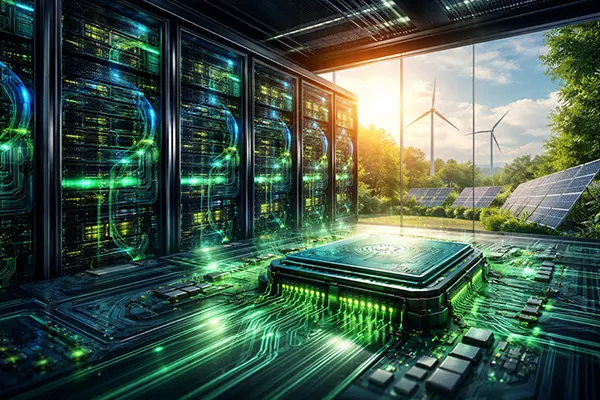
One of the most effective ways to reduce energy consumption is improving hardware efficiency. Modern AI accelerators — such as GPUs, TPUs, and custom AI chips — are designed specifically for machine-learning workloads. Compared with general-purpose processors, these chips perform mathematical operations more efficiently, allowing models to run faster while consuming less power per calculation.
Another important strategy is model optimisation. Researchers increasingly use techniques such as pruning, quantisation, and knowledge distillation. These methods reduce the size of neural networks or compress them without significantly affecting accuracy. Smaller models require fewer computations, which leads directly to lower energy usage during both training and deployment.
Software engineering also plays a role. Efficient data pipelines, better scheduling of workloads, and optimised machine-learning frameworks can reduce redundant computations. Many AI teams now measure performance not only in terms of accuracy but also in operations per watt, encouraging engineers to build systems that deliver more results with fewer resources.
The Role of Data Centres and Renewable Energy
Cloud providers have begun redesigning their infrastructure to support energy-efficient AI workloads. Advanced cooling technologies, such as liquid cooling and immersion systems, allow servers to operate at higher performance levels while using less electricity for temperature control. These solutions help data centres manage the heat generated by dense clusters of AI processors.
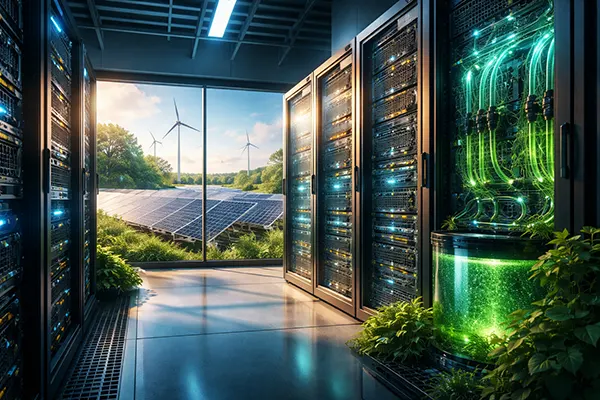
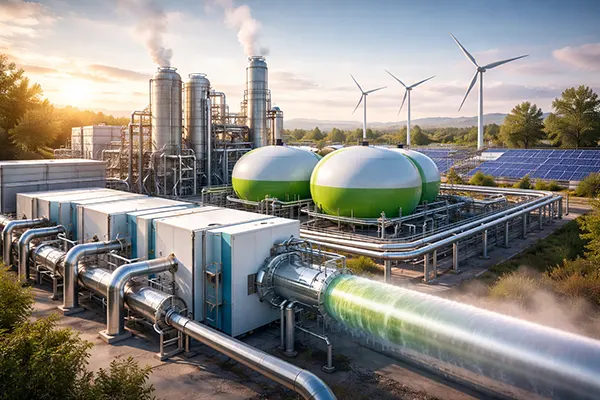
Location also influences energy efficiency. Many companies build new data centres in regions with access to renewable energy sources, including hydroelectric, wind, and solar power. By locating facilities near sustainable electricity generation, operators can significantly reduce the carbon footprint associated with AI workloads.
Grid integration is another developing area. Some modern data centres adjust their computing workloads based on the availability of renewable energy in the grid. When renewable production is high, more AI training jobs are scheduled. When energy supply is constrained, non-critical workloads are delayed. This approach aligns computing demand with sustainable energy availability.
How Energy Metrics Are Changing AI Development
The growing focus on electricity usage is influencing how researchers evaluate AI systems. Traditionally, machine-learning papers emphasised improvements in accuracy or benchmark performance. Today many studies include measurements of training time, computational complexity, and energy consumption. This broader evaluation encourages more responsible innovation.
Industry benchmarks are also evolving. Some organisations publish efficiency scores that compare models based on both performance and resource usage. These metrics reward designs that achieve competitive accuracy with fewer parameters or lower computational requirements. As a result, efficient architectures gain more attention within the research community.
Regulation may further accelerate this shift. Policymakers in several regions are exploring transparency requirements for large computing infrastructures. Companies may eventually need to disclose energy consumption or carbon intensity associated with AI services. Preparing for such standards encourages organisations to integrate efficiency considerations into system design from the beginning.
The Future of Sustainable Artificial Intelligence
Energy-efficient AI is likely to become a defining feature of the next stage of technological development. As models continue to grow more capable, simply scaling hardware will no longer be a practical solution. Engineers must balance computational power with responsible energy management, ensuring that innovation remains economically and environmentally sustainable.
Research directions are already shifting toward smaller, specialised models that perform specific tasks with high efficiency. Instead of relying on extremely large general systems for every application, developers increasingly deploy targeted models optimised for particular domains such as healthcare diagnostics, industrial monitoring, or logistics forecasting.
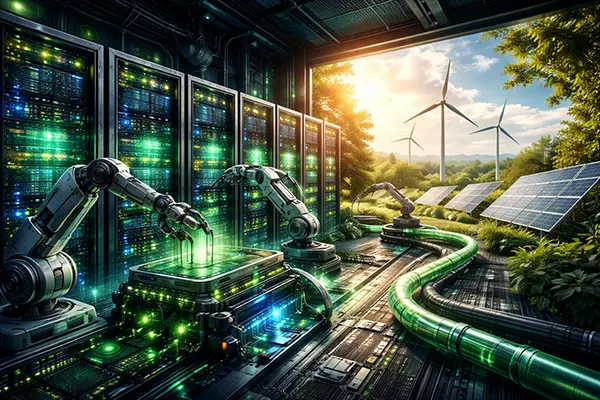
Collaboration between hardware designers, software engineers, and energy specialists will shape the next generation of AI infrastructure. Advances in semiconductor technology, improved algorithms, and renewable energy integration will together determine how efficiently artificial intelligence operates. By measuring not only speed but also electricity consumption, the industry is redefining what technological progress means.