Home Robotics 2025: A New Generation of Cleaning Robots, Manipulators and AI Assistants
The home robotics sector in 2025 is transforming everyday routines through smarter navigation systems, safer manipulation technologies and AI-driven assistants that adapt to individual household needs. This article explores the most relevant developments shaping domestic automation right now, offering a realistic overview of the technologies entering homes worldwide.
Advances in Cleaning Robots for Modern Households
Cleaning robots in 2025 rely on multimodal navigation that fuses LiDAR, 3D cameras and onboard machine learning models trained to understand room layouts with far greater accuracy. This combination enables vacuum robots to distinguish between cables, textiles, pet bowls and delicate items, significantly reducing user intervention during daily operation. The emphasis has shifted from simple obstacle avoidance to contextual recognition, allowing more confident movement in cluttered environments.
The newest vacuum and mop hybrids from leading manufacturers include improved self-maintenance features such as automatic brush cleaning, larger water tanks and antimicrobial filters designed to reduce odours. The ability to identify surface types — carpet, laminate, stone or vinyl — makes these devices more adaptable to mixed flooring typically found in contemporary homes. Many models now support maintenance logs in companion apps, helping users track consumable replacements with precision.
Energy efficiency also remains a priority. Most 2025 flagship cleaning robots use adaptive power regulation that limits suction intensity to what is strictly necessary. This reduces battery consumption while extending operational time. Fast-charging stations minimise downtime, enabling robots to cover larger homes within a single day.
Real-Time Mapping and Environment Awareness
Real-time mapping has evolved from static floor plans to dynamic environment models that update regularly based on user habits and daily changes in furniture arrangement. Robots learn which rooms are high-traffic zones and which areas require targeted, more intensive cleaning. These insights are processed locally, reinforcing data privacy and reducing reliance on cloud servers.
Households with pets benefit from enhanced debris detection systems capable of identifying concentrations of fur and adjusting cleaning routes accordingly. Many robots integrate allergen-reduction features that can detect dust concentration levels and activate specific cleaning patterns.
The integration of voice control through local, on-device AI provides faster responses and allows robots to continue functioning even without an active internet connection. This focus on decentralised computing improves reliability and minimises the risk of service interruptions.
Robotic Manipulators Designed for Safe Domestic Use
Household robotic arms were once limited to research laboratories, yet by 2025 simplified consumer-grade models are becoming more common. These devices prioritise safety through compliant actuators that reduce force when encountering resistance. This ensures that the robot can assist with tasks such as loading laundry, organising shelves, or passing objects without risk to users.
Domestic manipulators now incorporate tactile sensors and soft-grip materials, allowing them to interact with fragile items like glasses or plates. Their movement algorithms imitate human joint coordination, enabling precise, fluid motion even in small kitchens or utility areas. Most systems also feature predictive path planning that prevents collisions with pets or children.
The affordability of these devices is gradually improving thanks to modular parts and simplified assembly. Families can customise the reach, grip strength or mounting method depending on available space. Integration with central home hubs ensures that manipulators can collaborate with other devices, such as smart ovens or cleaning robots, creating coordinated task sequences.
Human-Centred Interaction and Reliability
A major focus of 2025 manipulator design is intuitive interaction. Users can teach robots new tasks through demonstration, moving the robotic arm manually while the system records optimal trajectories. This eliminates the need for programming knowledge and opens robotic assistance to a wider audience.
Redundant safety systems ensure that manipulators stop instantly upon detecting irregular motion, excessive pressure or unexpected obstacles. These measures build user confidence, particularly in households with vulnerable individuals who may rely on robots for daily support.
Reliability has also improved due to robust self-diagnostic functions. Robots can detect calibration drift, worn components or decreased grip efficiency and notify users before issues develop into operational failures. This proactive maintenance reduces service costs and extends device lifespan.
AI Home Assistants with Expanded Autonomy
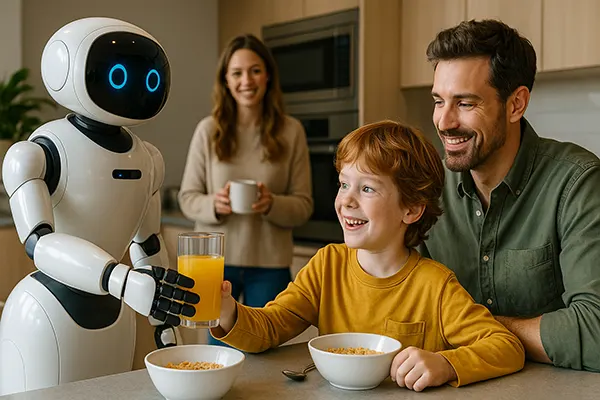
AI assistants in 2025 integrate robotics and natural-language understanding more seamlessly than earlier versions. Instead of functioning purely as stationary speakers, modern assistants coordinate with mobile robots, home sensors and wearable devices to provide personalised support. They can schedule cleaning tasks, monitor indoor air quality, or remind users about household chores based on learned routines.
These systems prioritise privacy, with many brands shifting towards fully localised language processing. By keeping audio data within the home rather than sending it to external servers, manufacturers aim to reduce the risk of data misuse. Local processing also enables faster response times and uninterrupted service even during network outages.
AI assistants can now analyse household patterns, identifying when residents typically return home, how often certain rooms are used and which appliances require energy-saving adjustments. They can coordinate heating cycles, lighting scenes and robotic operations to minimise unnecessary energy expenditure while maintaining comfort.
Coordinated Multirobot Systems
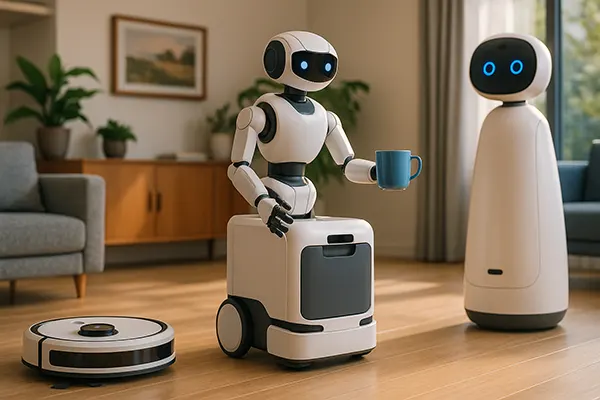
One of the most transformative features of 2025 home robotics is interoperability. Cleaning robots, manipulators and AI assistants communicate through shared protocols, allowing them to perform tasks collaboratively. For example, an AI assistant can instruct the manipulator to clear toys from the floor before triggering the vacuum robot to start its cleaning cycle.
This coordination extends to security functions. Some systems allow mobile robots to patrol the house while the AI assistant analyses sensor data for anomalies. If unusual movement is detected, the system can alert homeowners through secure notifications.
The result is a more coherent domestic ecosystem in which devices complement one another. Rather than functioning as isolated tools, home robots form a supportive network capable of handling a wider range of tasks with minimal user involvement.