Neuromorphic computing: how brain-inspired chips differ from classical AI computing
Neuromorphic computing is a hardware approach that borrows ideas from biology: instead of pushing huge blocks of numbers through dense matrix multiplications (as GPUs and many AI accelerators do), it processes information as sparse “spikes” that occur only when something changes. In 2026, interest in neuromorphic chips is practical rather than speculative: they are being tested and deployed where power budgets are tight, latency matters, and the outside world is noisy and event-driven—robotics, sensor fusion, always-on edge devices, and research systems that need real-time learning.
1) Architecture and data flow: spikes instead of continuous numbers
Classical AI computing is typically built around dense linear algebra. Whether it is a GPU, TPU, or an NPU inside a phone, the dominant workload is multiplying matrices to run neural networks—especially deep learning models. Even when networks are pruned or quantised, the underlying assumption stays the same: large arrays of weights and activations are moved through a compute pipeline that is designed for throughput.
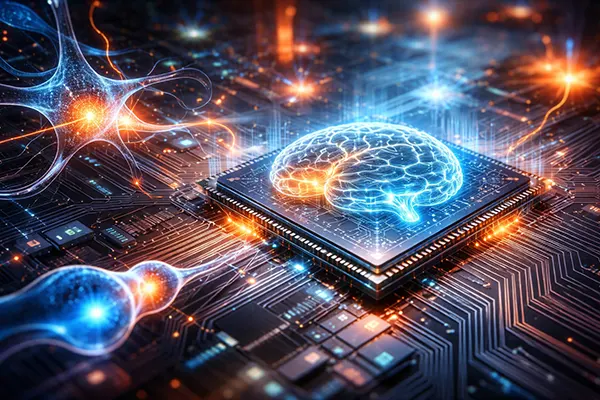
Neuromorphic chips flip that logic. They implement networks of spiking neurons where information is represented by timing and sparsity: a neuron “fires” only when a threshold is reached, and communication is carried as discrete events rather than constant streams. This event-driven model means computation often happens only when something meaningful changes in the input, which can drastically reduce unnecessary work.
Another architectural difference is how memory is treated. In many conventional AI systems, memory is physically separate from compute units, which leads to heavy data movement—often the hidden cost in energy and latency. Neuromorphic designs aim to keep memory and compute closely coupled, more like synapses and neurons in biology, so the system can update and react without constantly shuttling data back and forth.
What this means in practice in 2026
In 2026, the best-known neuromorphic research chips and systems still reflect this event-first philosophy. Intel’s Loihi line is widely cited for on-chip learning experiments and efficient spike-based computation, while SpiNNaker systems remain important for large-scale spiking neural network simulation. IBM’s TrueNorth remains a reference point historically for ultra-low-power spiking architectures, even if it is not a mainstream commercial product.
On the input side, event-based sensors are increasingly relevant: dynamic vision sensors (often called event cameras) output changes per pixel rather than full frames, matching neuromorphic processing far better than conventional cameras. That pairing is one reason neuromorphic computing is often discussed in connection with robotics and autonomy, where reacting quickly to motion and change is more valuable than reconstructing perfect images.
However, this is not a wholesale replacement of GPUs. For training large transformer models or running massive batch inference in a data centre, classical AI hardware remains the most efficient route. Neuromorphic chips are best viewed as specialised engines for specific tasks—particularly where the environment produces sparse, changing signals and where power constraints are strict.
2) Energy efficiency and latency: why neuromorphic chips can be radically frugal
The biggest selling point of neuromorphic computing is energy efficiency, and in many cases this is not marketing—it comes from first principles. Classical AI accelerators burn energy not only on math, but also on moving data, refreshing memory, and keeping large compute arrays active. Even if the input is quiet, the system typically continues to operate on fixed schedules: frames per second, batches, clock cycles.
Neuromorphic systems can idle in a much more literal sense. If there is no event, there may be almost no computation. When an event arrives, it triggers only the relevant parts of the network. This matches real-world signals: most sensors do not change dramatically every millisecond, and many decisions are driven by small deltas rather than full-state recomputation.
Latency is another practical advantage. Because event-driven processing can respond immediately to spikes, it avoids waiting for the next batch or frame. In time-critical control loops—micro-drones, robotic grasping, industrial monitoring—this can translate into faster reactions with lower compute budgets.
Where efficiency wins (and where it does not)
In 2026, neuromorphic computing is most persuasive in edge scenarios: always-on wake-word detection, low-power environmental classification, anomaly detection on sensor streams, tactile sensing in robotics, or on-device learning where sending data to the cloud is costly or impossible. These workloads are often continuous but sparse, and power efficiency directly impacts battery life and thermal limits.
That said, neuromorphic efficiency depends on the match between data and architecture. If the workload is dense—large images processed at high resolution as full frames, or transformer inference with heavy matrix math—the spiking approach may not outperform highly optimised GPU/NPU pipelines. Efficiency is not automatic; it is conditional on event sparsity and the structure of the model.
There is also a measurement nuance: neuromorphic chips may deliver exceptional performance per watt on certain benchmarks, but comparisons can be misleading if they do not account for accuracy, task equivalence, and end-to-end system costs (sensor, pre-processing, communication). A fair evaluation in 2026 focuses on the whole device and the real task, not a single synthetic number.
3) Software, learning, and limitations: why “brain-like” does not mean “easy”
Classical AI has a mature ecosystem: PyTorch, TensorFlow, ONNX, and a huge tooling universe. Models are trained with backpropagation, deployed with well-understood quantisation and acceleration pipelines, and integrated into production stacks with standard observability and monitoring. The hardware may vary, but the software story is comparatively stable.
Neuromorphic computing is different. Spiking neural networks (SNNs) can be trained in multiple ways—surrogate gradients, conversion from conventional neural networks, local learning rules such as spike-timing-dependent plasticity (STDP), or hybrid training schemes. In 2026, none of these methods is as universally dominant or as convenient as standard deep learning training for general-purpose tasks.
Programming models also differ. Many neuromorphic systems require thinking in terms of events, timing, and stateful dynamics rather than static layers. That can be powerful, but it raises the barrier to entry. For many teams, the question is not “Is it efficient?” but “Can we build and maintain a reliable product with it?”
Realistic expectations for adoption in 2026
In 2026, neuromorphic computing is best positioned as a complementary tool, not a replacement for mainstream AI stacks. It excels when models must be small, adaptive, and power-frugal, or when the input is naturally event-based. It is also valuable in research settings exploring continual learning, neurosymbolic hybrids, and embodied intelligence where timing and feedback loops matter.
The limitations are clear too. Large-scale language models, heavy vision transformers, and data-centre-class training pipelines are not moving to neuromorphic chips in any widespread way. The infrastructure, tooling, and economics strongly favour conventional accelerators. Neuromorphic computing competes only when the constraints are fundamentally different—especially on-device energy budgets and real-time responsiveness.
If you are evaluating neuromorphic options in 2026, the sensible approach is to start from the problem: What is the sensor? How sparse is the signal? Do you need on-device adaptation? What is the power envelope? If those answers point toward event-driven processing, neuromorphic chips can be a strong fit. If not, classical AI hardware will usually remain the simpler and more predictable choice.