Biohybrid Robots: How Living Muscle Cells Power Artificial Machines
A robot that moves using real muscle tissue rather than conventional motors might sound like an unusual scientific experiment, yet researchers have already demonstrated machines capable of walking, swimming and gripping objects through living muscle contractions. These devices are known as biohybrid robots because they combine biological cells with artificial structures. Recent developments between 2024 and 2026 have significantly expanded their capabilities, from two-legged walking mechanisms to robotic hands powered by cultured human muscle. Although most remain experimental, biohybrid robots are helping scientists understand how living tissues can control mechanical movement and whether biological components could eventually make certain machines softer, more adaptable and better suited to delicate tasks.
What Are Biohybrid Robots and How Do Living Muscles Make Them Move?
Biohybrid robots are machines built from a combination of living biological materials and manufactured components. Their structures may contain flexible polymers, miniature mechanical joints, artificial skeletons and laboratory-grown muscle tissue. Unlike conventional robots, which generally rely on electric motors or hydraulic systems to produce movement, muscle-powered biohybrid devices use contractions generated by living cells. The muscle tissue acts as a biological actuator, converting stimulation into physical force. This allows engineers to create machines that bend, pull or change shape using mechanisms similar to those found in animals and humans.
The idea behind biological movement is relatively straightforward. Muscles contain specialised cells that contract when they receive appropriate signals. During contraction, the tissue shortens and pulls against whatever it is attached to. In the human body, this action moves bones through tendons and joints. Researchers reproduce a simplified version of this arrangement by attaching cultured muscle tissue to artificial supports. When the cells contract, they pull the supports into a new position. The surrounding structure determines whether that force produces a swimming motion, bends a robotic finger or lifts a miniature leg.
Living muscle offers properties that are difficult to reproduce with conventional machinery, including natural flexibility and the ability to respond to different patterns of stimulation. However, biological components also introduce demanding operating conditions. Cells require nutrients, suitable temperatures, moisture and sufficient oxygen to remain functional. They can become fatigued, lose strength or die if their environment deteriorates. Consequently, a biohybrid robot is not simply a mechanical device fitted with biological parts. Its design must accommodate the needs of living tissue throughout operation, making the relationship between biology and engineering particularly important.
How Scientists Grow and Control Muscle Tissue in the Laboratory
Creating a muscle-powered robot generally begins with cultivating suitable muscle cells under controlled laboratory conditions. Researchers use cells derived from biological sources or established cell cultures, then encourage them to develop into organised muscle fibres. These cells are commonly grown on soft supporting materials that help them align in the same direction. Alignment matters because muscle fibres working together can generate more useful pulling force than randomly arranged cells. Depending on the experiment, scientists may use skeletal muscle cells, which normally support voluntary movement, or cardiac muscle cells, which naturally produce rhythmic contractions.
Once the muscle tissue develops, engineers connect it to a mechanical structure using carefully designed attachment points. These connections perform a role comparable to tendons, transferring the force of contraction to an artificial limb or flexible frame. Electrical stimulation is one established method of activating the muscle. Small electrodes deliver controlled signals that trigger contractions, allowing researchers to adjust the timing and movement of the device. Some experiments instead use muscle cells modified to respond to light. This approach, called optogenetics, allows selected muscle groups to contract when illuminated with particular wavelengths.
Controlling these contractions requires more than switching a signal on and off. The strength, duration and sequence of stimulation influence how far a component moves and whether separate muscle groups cooperate successfully. A robotic leg, for example, must lift and return to its starting position rather than simply bend once. Engineers may use flexible materials, opposing muscle groups or mechanical restoring forces to create repeated movement. Researchers also investigate whether carefully controlled exercise can improve engineered muscle performance. In laboratory studies, repeated stimulation has helped scientists examine how muscle tissue develops, adapts to physical loads and responds to fatigue.
Real Biohybrid Robots Developed by Researchers Between 2024 and 2026
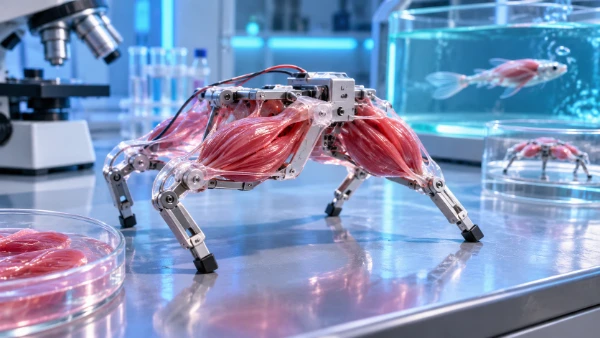
One important achievement came from researchers at the University of Tokyo and Waseda University, who developed a two-legged biohybrid robot described in the scientific journal Matter in 2024. The miniature machine combined cultured skeletal muscle with flexible silicone components and artificial legs. By stimulating muscle tissue attached to the legs, researchers demonstrated forward movement, stopping and controlled turning. The device operated underwater because its living tissue needed a moist environment. Although its movements were slow, the experiment showed that biological muscle could produce more controlled walking behaviour than the simple bending motions demonstrated in many earlier designs.
The Japanese team’s robot travelled forward at approximately 5.4 millimetres per second and could turn at around 1.4 degrees per second under experimental conditions. Its ability to pivot was especially significant because earlier muscle-driven robots often needed relatively wide spaces to change direction. The researchers achieved more precise movement by controlling the muscles associated with the two legs separately. However, the machine was supported by buoyancy and did not walk independently across ordinary dry ground. Its value lies in demonstrating how living muscle contractions can be coordinated with artificial joints to create recognisable stepping movements.
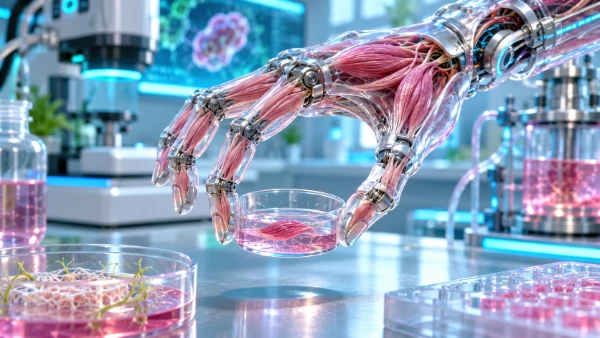
In February 2025, researchers from the University of Tokyo and Waseda University reported another development: an 18-centimetre biohybrid robotic hand powered by cultured human muscle tissue. Instead of relying on one thick muscle, the team combined multiple thin strands into bundles capable of producing sufficient pulling force. These bundles moved artificial fingers through a cable-driven mechanism. The hand demonstrated individual finger movements, formed a scissors gesture and manipulated a small laboratory object. The experiment also revealed a familiar biological limitation: muscle performance declined during prolonged stimulation but improved after a period of rest.
Swimming Robots, Four-Legged Walkers and New Muscle-Control Systems
Researchers have also used biological muscle to build miniature swimming machines. In February 2025, scientists associated with Harvard University and NTT Research described biohybrid rays constructed using cardiac muscle cells and flexible synthetic materials. Their designs had a wingspan of approximately 10 millimetres. By applying machine-learning methods to improve fin geometry, the team developed models with roughly twice the swimming efficiency of earlier designs produced through conventional biological imitation. The research demonstrated how the shape of an artificial body can influence the effectiveness of living muscle, even when the biological component itself remains comparatively simple.
In September 2026, engineers at the Massachusetts Institute of Technology reported a particularly thin biohybrid swimming robot. Its body consisted of a small gel film with two flexible fins covered by layers of living skeletal muscle cells. The cells had been engineered to contract in response to light, allowing researchers to control movement by illuminating different fins. During laboratory experiments, the robot swam through a simple underwater maze and reached speeds of approximately four body lengths per minute. This approach reduced the need for bulky muscle bundles and demonstrated that extremely thin biological structures could produce useful movement.
Other advances in 2026 included a light-controlled four-legged robot developed by researchers associated with the University of Tokyo. Its muscle tissues were arranged in opposing ring-shaped pairs, enabling the legs to lift and return during walking. Alternating muscle activation allowed the machine to move forward and turn. Separate research also improved electrical control by developing electrodes that concentrate stimulation around selected muscle tissues rather than activating neighbouring muscles unintentionally. Such developments address an important problem in biohybrid engineering: producing coordinated movement across several joints without losing control over individual muscle groups.
Practical Applications and Challenges of Muscle-Powered Robots
Medical research is among the most promising areas for biohybrid technology. Artificially grown muscle tissues can provide scientists with controlled models for investigating muscle development, fatigue, injury and recovery. When connected to small mechanical structures, these tissues allow researchers to observe how biological contractions translate into movement under different conditions. Such systems could support experiments involving muscle disorders or treatments designed to improve muscular function. Unlike a conventional laboratory cell sample, a muscle-powered device offers a visible mechanical response, helping researchers relate changes in tissue behaviour to measurable movement and force.
Biohybrid research may also contribute to the development of future prosthetic devices and rehabilitation equipment. Conventional prosthetic limbs already achieve sophisticated movements using motors, sensors and electronic control systems. Living muscle could eventually provide an alternative means of producing certain delicate motions, particularly where flexibility and biological responsiveness are useful. Nevertheless, the robotic hands demonstrated in research laboratories are not ready to replace established prosthetic technologies. Their limited strength, dependence on carefully maintained environments and difficulties with long-term operation remain substantial obstacles. Any medical application would also require extensive reliability, safety and clinical testing.
Another possible application involves small robots designed to operate in sensitive environments. Because living muscle is naturally soft, biohybrid machines might eventually manipulate fragile samples or travel through confined spaces where rigid mechanical components could cause damage. Swimming designs have attracted interest for future environmental monitoring, particularly in water-based settings. However, successfully moving through a laboratory dish does not establish that a device can navigate a river, collect useful information or survive changing environmental conditions. Those tasks would require additional sensing, control, protection and power systems that are not yet available in most experimental biohybrid robots.
What Must Improve Before Biohybrid Robots Become Practical Machines?
The greatest challenge is keeping the biological components alive and functional outside carefully controlled laboratories. Conventional motors can operate for extended periods with suitable electrical power and maintenance, whereas cultured muscle requires continuous biological support. Researchers must provide nutrients and oxygen while removing waste products and preventing contamination. Larger muscle tissues create additional difficulties because cells deep inside the material may not receive sufficient oxygen. This problem has encouraged scientists to develop thin muscle layers, bundled tissue structures and more effective methods of distributing nutrients. Long-term operation will depend heavily on solving these biological maintenance problems.
Strength and movement control also require improvement. Engineered muscle tissues generally produce limited forces compared with the mechanical demands of everyday robotic tasks. They may contract inconsistently, respond differently as they mature and weaken during repeated stimulation. Another difficulty is returning a joint to its original position after contraction. Natural limbs rely on coordinated muscle groups, elastic tissues and complex nervous-system control. Reproducing these functions in artificial machines requires carefully designed mechanical arrangements and reliable activation methods. Progress in opposing muscle structures, electrical stimulation and light-controlled movement is helping researchers address these limitations, but demonstrations remain considerably simpler than natural animal movement.
As of November 2026, muscle-powered biohybrid robots remain primarily experimental research devices rather than commercially established machines. Their recent progress is nevertheless measurable: scientists have demonstrated walking, turning, swimming, gripping and increasingly selective control of individual biological actuators. The next important milestones will involve longer tissue survival, stronger contractions, reliable movement outside specialised laboratory environments and the integration of sensors that allow robots to respond to changing conditions. The most realistic near-term benefits may come from scientific research and specialised biomedical testing, while independent robots powered by living muscle will require further advances in both tissue engineering and mechanical design.